How ADHD Classrooms Point the Way Toward Better Schools for Everyone
We are currently witnessing a crisis of engagement in our classrooms, and the common refrain is that students today just “can’t pay attention.” We blame social media, we blame video games, and we blame a lack of discipline. But there is a deeper reality that we are ignoring: The world has changed fundamentally, but our curriculum has only changed superficially.
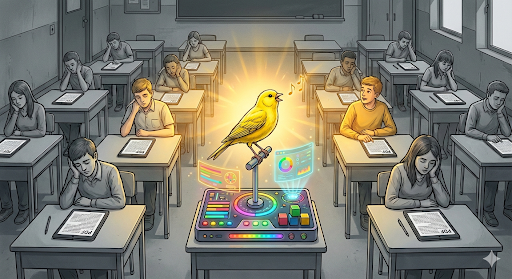
For decades, students with ADHD have been the outliers—the ones who couldn’t sit still in the factory-model rows, who couldn’t focus on rote memorization, and who needed “accommodations” just to survive the school day. But today, they are no longer just the outliers; they are the canaries in the coal mine.
The ADHD brain, with its high demand for stimulation, relevance, and immediate feedback, is actually the closest thing we have to a “modern” brain. The rest of society has caught up. We now live in an on-demand, high-speed, information-rich world. Yet, our education system is still trying to force 21st-century minds into 19th-century holes.
The “Digital Wrapper” Fallacy
If you walk into many modern classrooms, you will see rows of students staring at Chromebooks or iPads. At first glance, it looks futuristic. It looks like progress. But if you look closer at what is on those screens, the illusion breaks.
Far too often, schools have fallen into the trap of the “Digital Wrapper.” This is when we take a traditional, static assignment—like a worksheet of 50 math problems or a long, dense reading passage—and simply upload it to a learning management system.
We have convinced ourselves that because the student is tapping a screen instead of writing with a pencil, we are “meeting them where they are.” But we aren’t. We are just asking them to do the same passive, repetitive work, but now with the added strain of blue light and the endless distraction of the internet just one tab away.
For a student with ADHD, this is actually worse than the old method. The “Digital Wrapper” removes the tactile sensation of paper (which can help ground a student) and replaces it with a flat, glowing surface that demands sustained visual attention without offering any interactive reward.
How Society Changed the “Average” Brain
To understand why this approach is failing, we have to look at what school was originally designed to do. The traditional model was built for the Industrial Age. The goal was to produce a workforce that could tolerate repetitive tasks and follow instructions without question.
That world no longer exists.
We have moved from an economy of repetition to an economy of innovation. But it’s not just the economy that has shifted; it’s the human brain itself—or at least, the environment shaping it. We live in a “dopamine culture.” Information is fast, colorful, and delivered in short, engaging bursts.
For the neurotypical student of thirty years ago, sitting through a 45-minute lecture was boring, but manageable. For the modern student—regardless of diagnosis—it is excruciating. Their brains are wired for a pace of interaction that the classroom refuses to match.
The “Old Age” curriculum asks students to slow down and power down. A modern curriculum should ask them to speed up and plug in. We shouldn’t be trying to train modern children to tolerate boredom; we should be redesigning education to leverage their need for engagement.
So, if the “Digital Wrapper” is the problem, what is the solution? In Part 2, we will look at the specific strategies that actually work—and why designing for ADHD ends up helping everyone.
The Canary in the Classroom